
The Truth No One Admits:
Table of Contents
Meditation Doesn’t Work for Everyone — And That’s Not a Spiritual Failure

By Varshha Sangal
Meditation is often presented as the ultimate spiritual solution. Feeling anxious? Meditate. Feeling lost? Meditate. Feeling disconnected from Bhagwan? Meditate more. Over time, meditation has been positioned not just as a practice, but as a moral and spiritual benchmark. Those who can sit in silence are considered evolved. Those who struggle are quietly made to feel inadequate.
And yet, there is a truth many people carry privately but rarely say aloud: meditation doesn’t work for them. Not only does it not bring peace—it sometimes increases restlessness, anxiety, emotional discomfort, or even fear. When this happens, people assume they are doing something wrong. They blame their lack of discipline, their restless mind, their ego, or their insufficient faith.
What rarely gets questioned is the assumption itself.
How Meditation Became a Spiritual Test Instead of a Tool

Meditation was never meant to be a universal solution. It was a tool—one among many—for awareness. But over time, it became a spiritual standard. Silence was idealised. Stillness was glorified. And the ability to “switch off the mind” became a sign of advancement.
This created a quiet hierarchy. Those who meditated successfully were seen as disciplined and evolved. Those who couldn’t were encouraged to try harder, sit longer, or suppress more.
But the mind does not quiet itself through pressure. And the nervous system does not relax through force.
Why Meditation Can Feel Uncomfortable or Unsafe for Some People

For many people, especially those carrying unresolved emotional pain, trauma, or chronic stress, silence is not peaceful—it is overwhelming. When external distractions are removed, suppressed thoughts and emotions surface rapidly. The mind floods with memories, fears, and unfinished conversations. The body tightens. Breathing becomes shallow.
This is not failure.
This is unprocessed material coming to the surface.
Meditation creates space. If what fills that space has never been supported or processed, the experience can feel destabilising rather than calming.
This is why people search things like:
“Why does meditation make me anxious?”
“Why can’t I sit still while meditating?”
“Is meditation supposed to feel uncomfortable?”
These questions are often dismissed instead of addressed.
The Myth That a Quiet Mind Equals Spiritual Growth
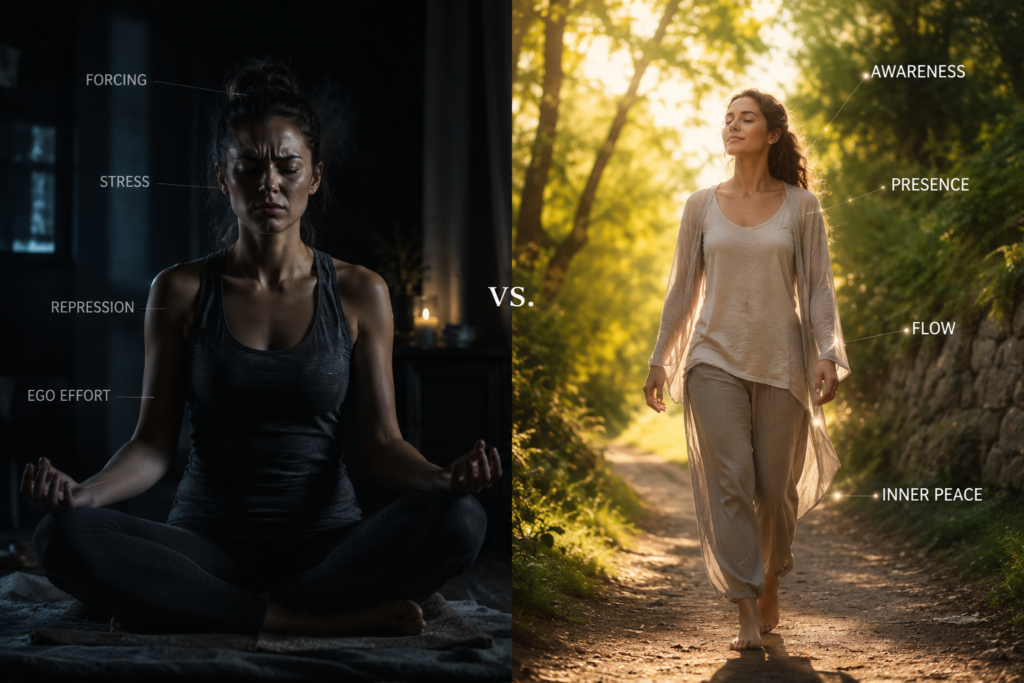
One of the most damaging myths is that a quiet mind is the goal. In reality, awareness is the goal, not silence.
A mind can be quiet due to suppression, dissociation, or emotional shutdown. And a mind can be active yet aware. Silence without awareness is not liberation. Awareness with movement is still consciousness.
Many people force silence without understanding what they are silencing. Over time, this creates internal tension. Meditation becomes something to endure rather than something that supports life.
That is not growth. That is self-control mistaken for self-realisation.
Why Some People Feel Worse After Meditating

People are often surprised—and ashamed—when meditation makes them feel worse. They experience emotional heaviness, agitation, sadness, or irritability. Instead of questioning the method, they judge themselves.
What is actually happening is simple: meditation removed distraction, but did not provide containment.
Without emotional safety and nervous-system regulation, silence amplifies what has been waiting underneath. This does not mean meditation is bad. It means meditation alone is not enough for everyone, at every stage.
Bhagwan Is Not Found Through Forcing Silence
There is another uncomfortable truth here. Many people believe that Bhagwan can only be experienced in silence. So if they cannot meditate, they assume they are disconnected from the divine.
But consciousness is not limited to stillness. Bhagwan is not hiding behind a quiet mind.
Awareness can arise in movement, conversation, creativity, service, inquiry, and even chaos. The idea that only silence leads to God has excluded many sincere seekers unnecessarily.
Bhagwan is presence, not posture.
Why Conscious Healing Often Needs to Come Before Meditation
For many people, emotional and subconscious healing needs to happen before silence can feel safe. When fear, grief, or trauma is held in the body, stillness feels like exposure, not peace.
Conscious healing approaches like Akashic awareness and Access Consciousness help people process what meditation often brings up too quickly. They create understanding, safety, and grounding first—so that silence, if and when it comes, is supportive rather than overwhelming.
Many people find that after healing, they don’t need to “try” meditation anymore. Awareness becomes natural. Presence arrives without force.
The Pressure to Meditate Can Create Spiritual Shame
Spiritual shame is rarely discussed, but it is widespread. People feel ashamed for not meditating “properly.” They feel inferior in spiritual spaces. They hide their struggles and pretend meditation is helping when it isn’t.
This shame disconnects people from honesty. And honesty is the foundation of real spirituality.
A practice that creates guilt is not serving consciousness.
There Is No One Right Way to Be Aware
This is perhaps the most liberating truth. Awareness is not owned by meditation. Silence is not the only gateway. Consciousness does not demand uniformity.
Some people access awareness through prayer.
Some through inquiry.
Some through healing work.
Some through movement.
Some through service.
Meditation is one door—not the door.
A More Compassionate Understanding of Spiritual Growth
Spiritual growth is not about forcing yourself into methods that don’t suit your nervous system. It is about listening to what supports your awareness.
If meditation feels supportive, beautiful.
If it feels overwhelming, something else is needed first.
Neither makes you more or less spiritual.
A Closing Reflection
If meditation has felt like a struggle for you, please stop blaming yourself. You are not broken. You are not undisciplined. You are not spiritually lacking.
You may simply be someone whose awareness needs safety before silence.
Bhagwan does not measure your spirituality by how still you can sit. Bhagwan responds to honesty, presence, and consciousness—wherever they arise.
If this reflection resonates and you feel drawn to explore awareness without pressure, comparison, or guilt, you can learn more about my work at:
Not to teach you how to meditate—
but to help you finally listen to what works for you.