

The Dark Truth No One Talks About:
How “Spirituality” Is Often Used to Avoid Healing
By Varshha Sangal
There is a truth many people sense but hesitate to say out loud: a lot of what is called spirituality today is not healing people—it is helping them avoid themselves.
This may sound uncomfortable, especially in a culture where spirituality is respected and devotion is sacred. But discomfort is often where honesty begins. Over the years, I have met countless people who pray regularly, attend satsangs, chant mantras, follow gurus, quote scriptures, and speak about surrender—yet remain emotionally stuck, fearful, reactive, or deeply unhappy. When asked what they feel inside, many admit they are exhausted, confused, or numb.
This is not because spirituality failed them. It is because spirituality was used as a shield, not a mirror.
Table of Contents
The Myth That Spirituality Automatically Makes You Healed
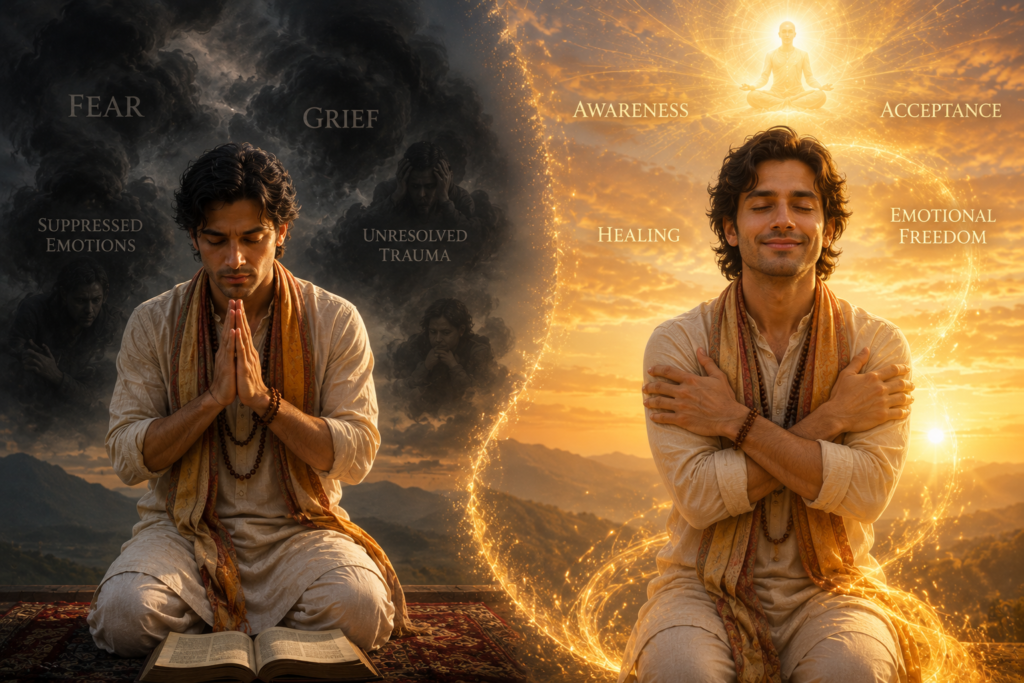
One of the biggest myths people believe is that if you are spiritual enough, your emotional pain should disappear. That prayer should dissolve trauma. That devotion should cancel anxiety. That surrender should remove responsibility.
So when pain remains, people assume one of two things: either they are not spiritual enough, or they must endure suffering silently to prove faith.
Both beliefs are harmful.
Spiritual practices can support healing, but they do not replace it. Chanting does not automatically process grief. Meditation does not automatically resolve childhood wounds. Surrender does not automatically dissolve fear stored in the nervous system. When these realities are ignored, spirituality becomes a way to bypass emotional work, not complete it.
This phenomenon is rarely named, but it has a name: spiritual bypassing.
How Spiritual Bypassing Looks in Real Life

Spiritual bypassing does not look dark or negative on the surface. It often looks very “positive.” People say things like, “Everything happens for a reason,” while suppressing anger. They say, “I have surrendered,” while staying in harmful situations. They say, “I don’t have expectations,” while feeling deeply resentful. They say, “I’m detached,” while being emotionally unavailable.
On the outside, this looks spiritual. On the inside, it creates fragmentation.
When emotions are denied instead of processed, they don’t disappear. They show up as anxiety, passive aggression, exhaustion, repeated relationship patterns, physical symptoms, or chronic dissatisfaction. People continue doing spiritual practices, but feel no real relief—and often feel guilty for that too.
Why This Pattern Is So Common in India
In Indian spiritual culture, endurance is often glorified. Suffering is romanticised. Silence is praised. Questioning is discouraged. Emotional expression is often labelled weakness or ego.
So many people learn early that being “good” spiritually means being quiet, patient, and self-sacrificing—even at the cost of their emotional truth. Over time, spirituality becomes something people use to manage pain instead of understand it.
This creates a dangerous contradiction: people appear spiritual, but feel disconnected from themselves.
Bhagwan Was Never Meant to Replace Self-Awareness
One of the most uncomfortable but important truths is this: Bhagwan does not replace inner work.
Bhagwan supports awareness. Bhagwan does not cancel it.
If prayer is used to avoid feeling anger, the anger stays.
If devotion is used to avoid grief, the grief waits.
If surrender is used to avoid boundaries, resentment grows.
Using God to bypass emotions does not make you more spiritual. It makes you more disconnected.
True spirituality does not ask you to rise above your humanity. It asks you to enter it consciously.
Why “Positive Thinking” Can Become a Trap
Another dark truth is how positivity is weaponised in spiritual spaces. People are told to stay high-vibration, think positively, avoid negativity, and trust the universe—often at the cost of honesty.
When people are told not to feel sadness, anger, jealousy, or fear, they learn to suppress instead of integrate. Suppression creates internal pressure. Pressure eventually breaks somewhere.
Spirituality that does not allow the full range of human emotion becomes performative. It looks calm, but feels tense. It looks peaceful, but feels heavy.
Healing does not require you to be positive. It requires you to be real.
Conscious Healing Is Not Anti-Spiritual — It Is Pro-Spiritual
This is where conscious healing approaches like Akashic awareness and Access Consciousness become deeply relevant and, yes, controversial. They challenge the idea that suffering is necessary, that silence is always virtuous, and that endurance equals enlightenment.
Conscious healing does not disrespect devotion. It removes fear and guilt from it.
When people are supported to feel emotions safely, process subconscious patterns, and understand their inner world, something unexpected happens: their spirituality deepens. Prayer becomes honest. Surrender becomes lighter. Faith becomes lived instead of performed.
People stop using Bhagwan to escape themselves and start experiencing Bhagwan through themselves.
Why This Truth Makes People Uncomfortable
This topic is uncomfortable because it removes spiritual shortcuts. It asks people to take responsibility for their inner world instead of outsourcing everything to destiny, karma, or God’s will.
It also challenges spiritual hierarchies that benefit from obedience without awareness.
But discomfort is not danger. It is growth.
Spirituality that cannot tolerate honest inquiry eventually becomes control, not consciousness.
A Different Way to Understand True Bhakti
True bhakti does not ask you to disappear. It asks you to be present. It does not ask you to suppress emotions. It asks you to bring them into awareness. It does not ask you to tolerate harm. It asks you to listen to truth.
When devotion and awareness come together, healing happens naturally. Not dramatically. Not magically. But honestly.
A Closing Reflection
If you have ever felt spiritual but unhealed, devoted but exhausted, surrendered but stuck—please know this: you are not failing spirituality.
You may simply be ready for a more honest one.
Bhagwan does not need your perfection. Bhagwan responds to your awareness.
If this reflection challenges you, sit with it gently. Truth does not rush.
And if you feel drawn to explore spirituality that includes healing instead of avoiding it, you can learn more about my work at:
Not to make you “more spiritual”—
but to help you finally feel whole.