
Why Women Heal Faster Than Men (A Consciousness & Nervous System Perspective)

The idea that women often heal faster than men can sound controversial, even unfair. Yet across therapeutic, spiritual, and consciousness-based work, a consistent pattern emerges: women, on average, tend to access emotional healing more quickly once they feel safe enough to begin.
This does not mean women suffer less. In many cases, they suffer more. But suffering and healing are not the same process.
This observation is explored carefully in the work of Varshha Sangal, whose trauma-aware practice at varshasangal.com focuses on how emotional access, nervous system conditioning, and social learning influence the pace of healing—not intelligence, strength, or willpower.
Healing Speed Is Not About Desire
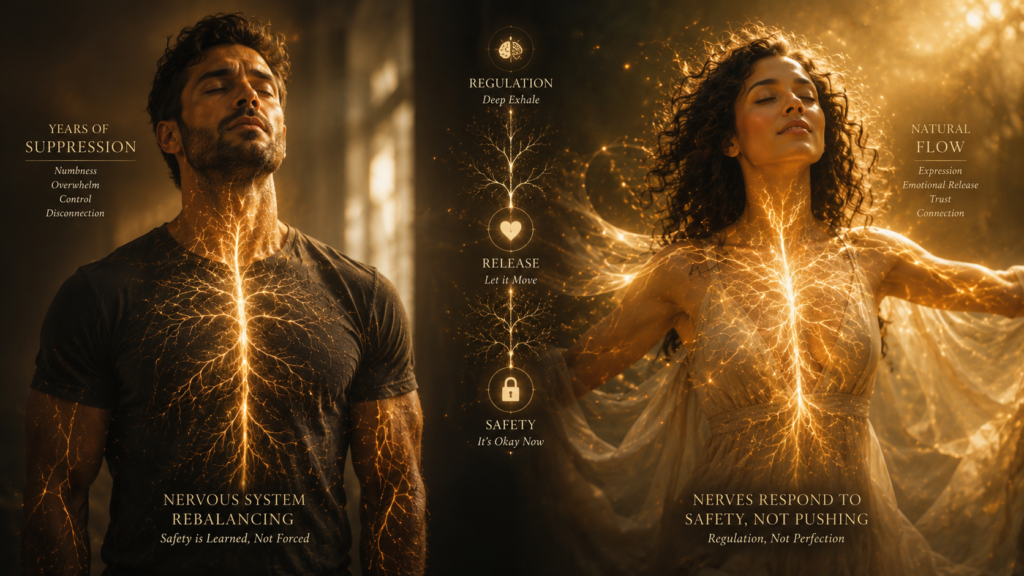
Both men and women want relief. Both feel pain. The difference lies not in motivation, but in permission.
Healing requires:
- Emotional access
- Willingness to feel
- Nervous system flexibility
- Safety in vulnerability
These are not personality traits. They are learned capacities.
Women, due to biological, social, and relational conditioning, are often allowed—sometimes forced—to develop emotional awareness earlier in life. Men, on the other hand, are often trained to suppress it.
This conditioning shapes healing trajectories.
The Nervous System Difference
From early childhood, many boys are taught:
- “Be strong.”
- “Don’t cry.”
- “Handle it yourself.”
- “Emotions make you weak.”
Over time, the nervous system learns that emotional expression is unsafe. Survival depends on control.
This creates high-functioning emotional shutdown.
Women, while often burdened with emotional labor, are usually given more permission to express and process feelings. Their nervous systems, though stressed, retain more emotional mobility.
Mobility allows healing.
Emotional Access vs Emotional Suppression

Healing requires accessing emotion without being overwhelmed by it.
Women are more often socialized to name feelings, talk about them, and seek support. This doesn’t guarantee healing—but it lowers the barrier to entry.
Men often approach healing only when:
- Symptoms become physical
- Relationships break down
- Burnout becomes unavoidable
By that point, the nervous system is deeply entrenched in control patterns. Healing then requires an additional step: learning to feel safely.
This adds time—not because men are resistant, but because the system needs retraining.
Vulnerability as a Learned Skill
Vulnerability is not natural or unnatural. It is contextual.
When vulnerability has historically led to shame, rejection, or punishment, the system learns to avoid it. Healing work then feels threatening.
This is why some men struggle in early sessions. It’s not lack of depth—it’s lack of safety history.
Once safety is established, men often experience profound shifts—but it may take longer to reach that threshold.
Why Women Often Heal in Layers
Women frequently engage healing earlier and repeatedly across life stages—relationships, identity shifts, motherhood, career changes.
They are often already familiar with emotional processing. When trauma-aware work is introduced, their system recognizes the pathway.
Healing then happens in layers, rather than starting from zero.
At varshasangal.com, many female clients report that once regulation begins, emotional release feels natural rather than foreign.
Why Men’s Healing Can Look Slower—but Go Deep
When men do commit to healing, the work can be exceptionally deep and transformative. Once emotional access opens, long-held suppression releases.
But the initial stages may look like:
- Intellectualization
- Skepticism
- Restlessness
- Discomfort with silence
This is not resistance—it’s adaptation.
The system is learning a new language.
Healing Is Not a Competition

It’s important to be clear: this is not about superiority.
Women heal faster on average because:
- Emotional access is less threatening
- Expression is more normalized
- Support-seeking is more socially accepted
Men heal deeply when:
- Safety replaces performance
- Vulnerability is met without judgment
- Control is no longer required
Both paths are valid. They simply begin from different starting points.
Why Gender Norms Matter in Healing
Gender norms shape nervous systems.
When a culture rewards emotional expression, healing accelerates. When it rewards stoicism, healing delays.
This is not a flaw—it’s conditioning.
Varshha Sangal’s work emphasizes creating gender-neutral safety—spaces where neither suppression nor emotional flooding is required. Healing adapts to the individual system, not stereotypes.
What Actually Equalizes Healing Speed
The factor that equalizes healing speed between men and women is safety.
When the nervous system feels:
- Accepted
- Unjudged
- Unpressured
Healing unfolds naturally, regardless of gender.
This is why trauma-aware facilitation matters more than techniques. The container heals as much as the process.
What This Means for Couples
In relationships, one partner (often the woman) may heal faster. This can create tension.
The solution is not slowing one person down or pushing the other faster. It’s respecting timing.
Healing is not linear or synchronized. Mutual understanding prevents resentment.
Final Reflection
Women don’t heal faster because they are weaker.
Men don’t heal slower because they are broken.
They heal differently because they were taught differently.
When healing spaces honor safety over performance, everyone heals—at their own pace, in their own way.