
Gaslighting: When Someone Makes You Doubt Your Own Reality
Have you ever walked away from a conversation more confused than when it started? You know what happened. You remember exactly how it made you feel. And yet, somehow, after talking to that one person, you start questioning your own memory, your own emotions — even your own sanity.
That quiet, creeping confusion is often the sign of something specific: gaslighting.
The word gets thrown around a lot on social media today — but psychologically, gaslighting means something far more precise than lying, disagreeing, or having a bad argument.
What Is Gaslighting? (Meaning and Definition)
Gaslighting is a repeated pattern of manipulation in which someone’s perception, memory, or understanding of events is deliberately undermined — often to the point where the person begins doubting their own sense of reality.
Psychologists link gaslighting to real, measurable harm: diminished self-trust, loss of personal agency, and ongoing psychological distress. What makes it so damaging isn’t just being fed false information. It’s being made to doubt your own ability to recognize what’s true in the first place.
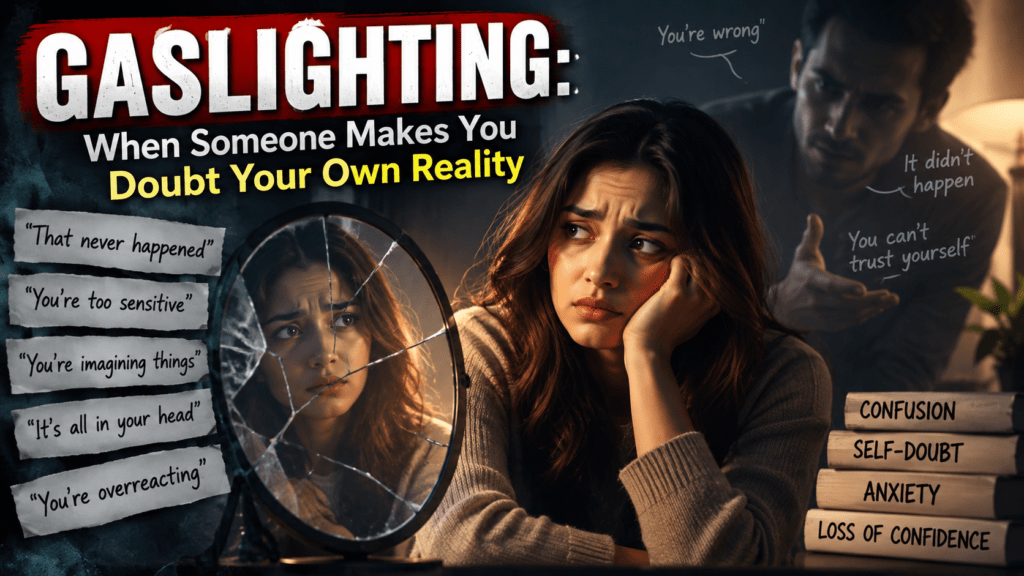
Table of Contents
How Gaslighting Shows Up (Common Signs)
Gaslighting rarely looks dramatic at first. It builds slowly, one small moment at a time. Watch for these recurring patterns:
- Flat-out denial — repeatedly denying they said or did something you clearly remember
- Minimizing your feelings — brushing off your emotions as unimportant
- The “overreaction” label — framing your concerns as you being “too sensitive” or “dramatic”
- Memory doubt — suggesting your memory of events can’t be trusted
- Deflection — turning the conversation around so you become the problem, not the original issue
On their own, phrases like “you’re too sensitive” or “that never happened” might seem harmless. It’s the pattern, repeated over time, that quietly shifts focus away from the original behavior and onto the person raising the concern.
Gaslighting vs. Normal Disagreement: What’s the Real Difference?
Not every mismatched memory is gaslighting. People genuinely recall the same event differently. They forget conversations. They misunderstand each other. That’s simply human.
Healthy disagreement allows two people to accept that they experienced the same moment differently, without either person’s reality being erased.
Gaslighting is different. It becomes a concern when one person’s perception is consistently painted as unreliable — and every attempt to communicate is turned into “proof” that something is wrong with them.
Why It’s So Hard to Notice: The Role of Power
Researcher Paige Sweet has studied gaslighting extensively, particularly within intimate relationships and abusive dynamics. Her research shows that gaslighting becomes especially damaging when it happens alongside an existing power imbalance in the relationship.
When one person holds more emotional, social, or practical power, it becomes far harder for the other person to challenge their version of events — or even hold onto confidence in their own experience. Gaslighting, in other words, isn’t just about personality. It’s shaped by the power structure of the relationship itself.
The Psychological Toll Over Time

Instead of questioning the other person’s behavior, the person being gaslit slowly starts questioning themselves. Common patterns include:
- Replaying conversations over and over
- Over-analyzing their own words
- Constantly seeking reassurance from others
- Apologizing even when unsure what they did wrong
- Eventually, going quiet — because they’ve learned their experience will be dismissed anyway
That growing uncertainty isn’t a personality flaw. It’s a response to a relationship where their perception has been undermined again and again.
Gaslighting and Spirituality: Intuition vs. Discernment
For spiritually-minded people, gaslighting adds another layer of difficulty. Many spiritual traditions emphasize intuition and inner knowing — but spiritual awareness doesn’t mean treating every feeling as unquestionable truth.
Emotions can be shaped by fear, past wounds, attachment, and expectation. This is where two ideas become useful:
- Intuition signals that something deserves your attention
- Discernment helps you understand what that feeling actually means
Rather than assuming an uncomfortable feeling automatically proves someone has bad intentions, it helps to slow down and observe. Watch how someone responds when you disagree, set a boundary, express hurt, or ask for accountability. Their words matter — but their repeated behavior tells the real story.
Why the Word “Gaslighting” Should Be Used Carefully
In an age where psychological terms spread fast on social media, almost any unpleasant interaction gets labeled with a clinical name. But:
- Someone forgetting something isn’t automatically gaslighting.
- Someone disagreeing with you isn’t automatically gaslighting.
- Someone getting defensive isn’t automatically manipulation.
Using the term carefully protects its real meaning — and stops psychological language from becoming just another way to judge people without real evidence.
A more useful question than “is this person a gaslighter?” is often: How does this relationship make me feel about myself? If interactions with someone repeatedly leave you confused, small, anxious, or unsure of your own judgment, that pattern deserves attention — regardless of what label you eventually give it.
How to Protect Yourself From Gaslighting
You don’t need to become suspicious of everyone to protect your reality — constant suspicion is exhausting in its own way. Instead, try to stay grounded while remaining open to occasionally being wrong:
- Write things down. A simple record of events helps when your memory keeps getting challenged.
- Talk to someone outside the relationship. A trusted friend or therapist offers an outside perspective you can’t get alone.
- Remember: boundaries don’t need agreement. You’re allowed to decide what behavior you will and won’t accept — no permission required.
Healing After Gaslighting: Rebuilding Self-Trust
The deepest wound of gaslighting usually isn’t the lie itself — it’s that, over time, you stop listening to yourself. You become so focused on proving what happened that you lose touch with your own feelings, values, and boundaries.
Recovery, then, is about more than spotting manipulation. It’s about rebuilding your relationship with yourself.
That process asks for curiosity, not absolute certainty. It means learning to separate:
- Facts from interpretations
- Emotions from assumptions
- Intuition from fear
Healthy self-trust doesn’t mean believing you’re always right. It means knowing you’re capable of recognizing your mistakes, learning from them, and still making thoughtful decisions afterward.

Where Psychology and Spirituality Meet
Psychology teaches us to examine patterns, perception, and how relationships affect our emotional wellbeing. Spirituality invites deeper awareness of our inner experience. Together, they build something powerful: awareness that is neither blindly trusting nor endlessly suspicious.
You can stay open-minded without abandoning your inner knowing. You can hear someone else’s perspective without handing them total authority over your own reality. You can accept that your perception is sometimes imperfect — without letting someone else define your truth for you.
FAQs About Gaslighting
Q: Is gaslighting always intentional? Not always — but a repeated pattern of undermining someone’s reality is what defines gaslighting, whether or not the person fully recognizes their own intent.
Q: What’s the first step if I think I’m being gaslit? Start documenting events as they happen and talk to someone you trust outside the relationship for an outside perspective.
Q: Can gaslighting happen outside romantic relationships? Yes — it can occur in families, friendships, and workplaces, especially wherever a power imbalance exists.
Final Thoughts
The opposite of gaslighting isn’t simply proving another person wrong. It’s building a relationship with yourself where your experiences, emotions, and boundaries are taken seriously — while still being examined with honesty and discernment.
Self-trust doesn’t mean never being wrong. It’s the quieter understanding that even when you are, you can recognize it, learn from it, and find your way back to yourself.