
I Did Bhagwan Ki Bhakti for Years — Then the Akashic Records Told Me the Truth No One Warned Me About

By Varshha Sangal
“Bhakti opens your heart. Akashic Records reveal the pattern. But until your body feels safe enough to let go, freedom remains unfinished.”
This is the hard, research-informed truth I share with clients every week. I meet two types of seekers: those who live in devotion — chanting, seva, temples, absolute surrender to Bhagwan — and those who come with the thirst for clarity — Akashic Records readings, karmic maps, past-life insight. Both paths are powerful. Both can also leave you stuck.
In this piece I explain, with depth and clarity, why bhakti vs Akashic Records is the wrong debate, how trauma and the nervous system change the equation, and how you can integrate devotion + Akashic insight so your life actually transforms — not just your beliefs.
Bhakti: what it heals (and where it stops)

Bhakti — sincere devotional surrender — is among the most effective practices for softening the conditioned ego. Historically and practically, bhakti:
- Opens the heart and creates emotional refuge.
- Reorient identity (from “I” as separate to “I” as lover/servant).
- Builds community and ritual safety that protect mental health.
That is why devotees feel immediate relief in grief, devotion helps sustain people in crisis, and ritual creates meaning. But bhakti primarily works at the relational and belief level: it shifts how you see life.
Here’s the catch most devotees don’t notice until years later: a softened heart does not automatically rewire stored survival patterns. You can chant for decades and still:
- Be triggered in relationships,
- Repeat abandonment/attachment cycles,
- Carry anxiety in the body, or
- Recreate the same karmic dynamics.
Devotional surrender can, in practice, become a spiritual bypass if it’s used to avoid feeling what the body still holds. People say, “This is God’s will,” and bury anger, grief, and shame. Meaning changes the story; it doesn’t always discharge the nervous system.
Akashic Records: what they reveal (and what they don’t do alone)

Akashic Records readings are a modern tool for pattern-level clarity. A proper reading shows you:
- The recurring soul themes that underlie your relationships and choices,
- Where a karmic loop began (personal or ancestral), and
- Which lessons are incomplete — and why they keep returning.
Searches like “does Akashic Records reading really work” or “Akashic records meaning” reflect this hunger for understanding. And yes — many clients feel immense relief from insight.
But insight by itself is not released. Knowing why a pattern exists doesn’t make your nervous system stop reacting the old way. Akashic clarity is a map — invaluable — but maps do not drive the car. The body must change its default.
The scientific bridge: nervous system + somatic charge
Contemporary trauma science and somatic psychology show what devotional and insight practices sometimes miss: trauma is stored as a physiological state, not just narrative. The autonomic nervous system encodes survival responses; unless those responses complete (discharge) or are re-regulated, the pattern repeats regardless of spiritual understanding.
This is why, in practice:
- Devotion soothes perception but may not release a trauma loop, and
- Akashic insight clarifies motive but may not update baseline safety.
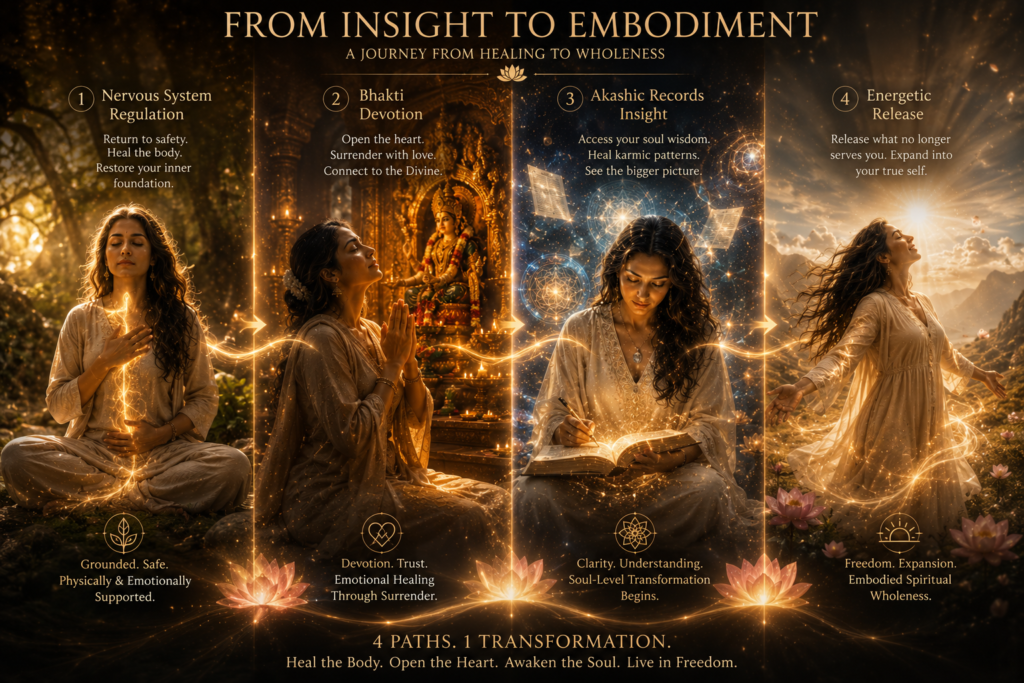
Integration requires sequencing: regulation → heart (bhakti) → insight (Akashic) → embodied release. When these elements are aligned, liberation stops being theoretical.
Real examples (very common)
- The Devotee Who Keeps Getting Triggered: A devotee who has attended satsang and recited mantras for years still freezes in conflict with their partner. The heart is surrendered, the mind has meaning — but the body was never taught it’s safe to be vulnerable in relationships.
- The Client with a Brilliant Akashic Reading: Someone receives a detailed Akashic reading explaining repetitive relationship patterns. They feel validated and cry — yet months later the same dynamic reappears. Insight came; nervous-system reset didn’t.
In both cases the missing step is embodiment: nervous-system work that allows stored charge to complete.
How to combine bhakti and Akashic Records correctly (practical sequence)
From clinical practice and a review of trauma-informed approaches, this sequence creates durable change:
- Begin with gentle regulation. Short, somatic practices to down-regulate chronic activation (breath, grounding, polyvagal-aware exercises).
- Bring bhakti in as integration. Ritual and devotion soften defenses so deeper material can be present without overwhelm.
- Use Akashic Records for orientation. The reading reveals what to focus on — not as entertainment, but as targeted insight.
- Do energetic/somatic completion. Trauma-informed energy psychology, somatic experiencing, or gentle Bars/energy sessions to discharge stored charge. This is what actually updates the baseline.
Put simply: regulate → soften → understand → release.
Individual vs Family Akashic Records: why family sessions matter
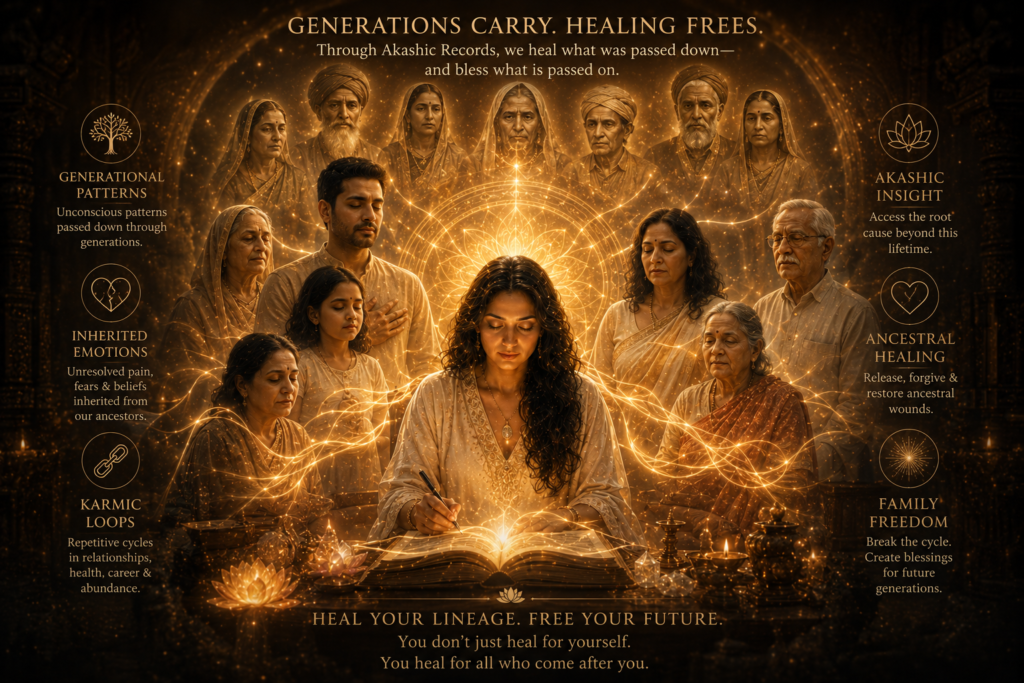
Karma is often systemic. Some patterns belong to the family field — not just you. If your suffering echoes across generations, an individual reading may illuminate your role, but a family Akashic Records reading often reveals the ancestral contracts, parental bindings, and generational survival strategies that keep patterns alive.
I offer both:
- Individual Akashic Records Reading — clarity on personal karmic themes, relationships, and soul lessons.
https://varshachandra.com/akashic-records-reading/ - Family Akashic Records Reading — ancestral and family field work to address transgenerational karma.
https://varshachandra.com/akashic-records-family/
Both readings are orientation tools designed to be paired with nervous-system and integration work — not as mystical shortcuts.
Who should book a session (and who shouldn’t)
Book a reading if:
- You’ve done the devotional work and still feel stuck,
- You’ve had spiritual or therapeutic insight but patterns repeat,
- Your issues feel generational or larger than your own story,
- You want practical guidance, not just spiritual comfort.
Don’t book a reading if:
- You want entertainment or prediction,
- You are seeking avoidance of responsibility, or
- You expect a miracle without follow-through.
Final note
Bhakti is sacred. Akashic Records are wise. But God didn’t design devotion to imprison your nervous system. Liberation requires devotion + clarity + embodiment. If you’re ready to stop repeating patterns — not just explaining them — schedule an orientation call or explore the readings below. Real devotion meets real healing here.
Book an Individual Akashic Records Reading: https://varshachandra.com/akashic-records-reading/
Book a Family Akashic Records Reading: https://varshachandra.com/akashic-records-family/
Meta title: Bhagwan Ki Bhakti vs Akashic Records — Why Devotion Alone Didn’t Free Me (And What Does)
Meta description: Devotion soothes, Akashic insight clarifies — but trauma lives in the body. Learn a practical, research-informed sequence to integrate bhakti, Akashic Records, and nervous-system healing so change actually lasts. Book individual or family Akashic sessions.