
Reiki vs Access Consciousness — Why One Heals Slowly and the Other Changes Everything Faster Than You Expect

By Varshha Sangal
India’s leading certified Access Consciousness Facilitator · 20+ years of global healing practice
There’s a simple reason this comparison matters: people come to me after years of trying “energy healing” and still feel stuck. They say, “I did Reiki and felt relaxed, but my life didn’t change.” Others say, “I did Access Bars and my mind quieted — but will this actually change my relationships, my career, my patterns?” After two decades of international practice, teaching, and clinical observation, I can tell you with clarity what these modalities do, where they overlap, where they diverge, and how to use them together so your life actually shifts — not just your nervous system’s immediate state.
This is an in-depth, practice-focused essay. I’ll explain the mechanisms as practically as possible (no mystic fluff), describe who benefits most from each approach, cover sequencing and integration, and give clear guidelines for choosing and measuring real change.
What Reiki is — practice, mechanism, and clinical niche

What people experience.
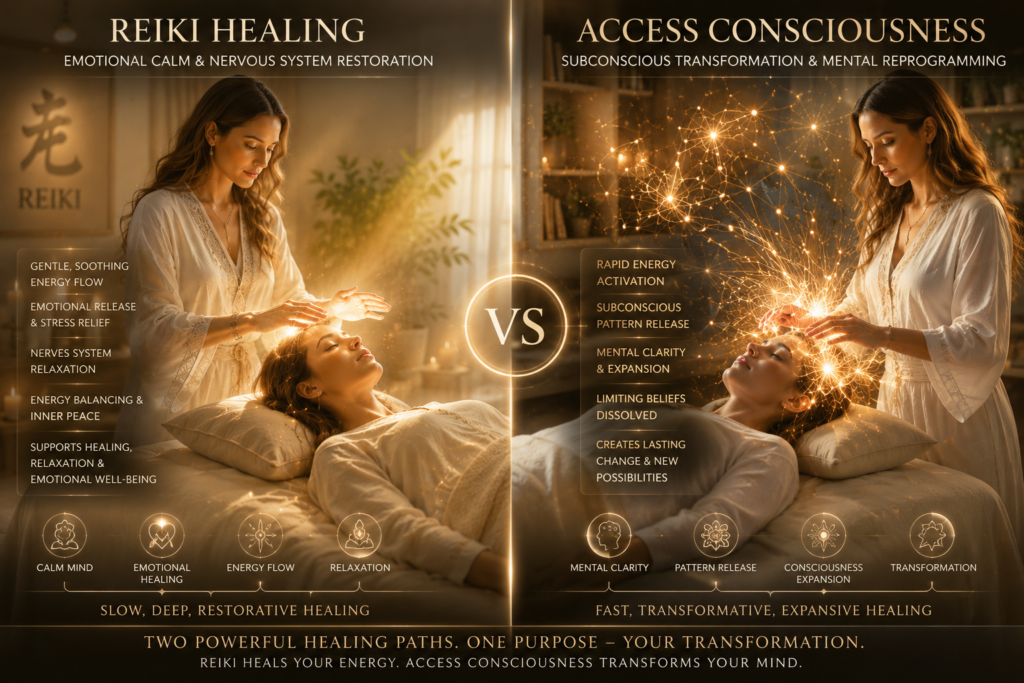
Reiki is a Japanese-origin energy healing practice that channels “universal life force” through light touch (or near touch) to promote relaxation and balance. Clients commonly report deep rest, warmth, emotional softening, and reduced tension. It is profoundly gentle: the practitioner acts as a non-judgmental conduit; the receiver receives.
How it appears to work (practical language).
Reiki primarily supports autonomic regulation — a downshift from sympathetic (fight/flight) activation toward parasympathetic calm. This has measurable benefits: improved sleep, reduced cortisol-related symptoms, and subjective reductions in anxiety and pain. Practically speaking, Reiki increases interoceptive safety (the sense “my body is OK”), which is an essential foundation for any further therapeutic work.
Clinical niche and limits.
Reiki is excellent for:
- Acute stress, exhaustion, and burnout recovery
- Gentle support during illness or medical recovery
- Clients who need non-invasive, non-verbal containment
- People early in their healing journey who are emotionally fragile
Reiki’s common limitation — and where many clients feel disappointed — is that it rarely interrupts deep subconscious programs by itself. It can reduce the symptoms those programs create (tension, anxiety, insomnia), but it often does not dismantle the underlying narratives and conditioned responses driving repeated life patterns (e.g., self-sabotage, compulsive relationship dynamics). Think of Reiki as restorative care for the system; it creates breathable space but is rarely the primary tool for reprogramming identity-level content.
What Access Consciousness is — tools, mechanism, and outcomes
What Access practitioners do.
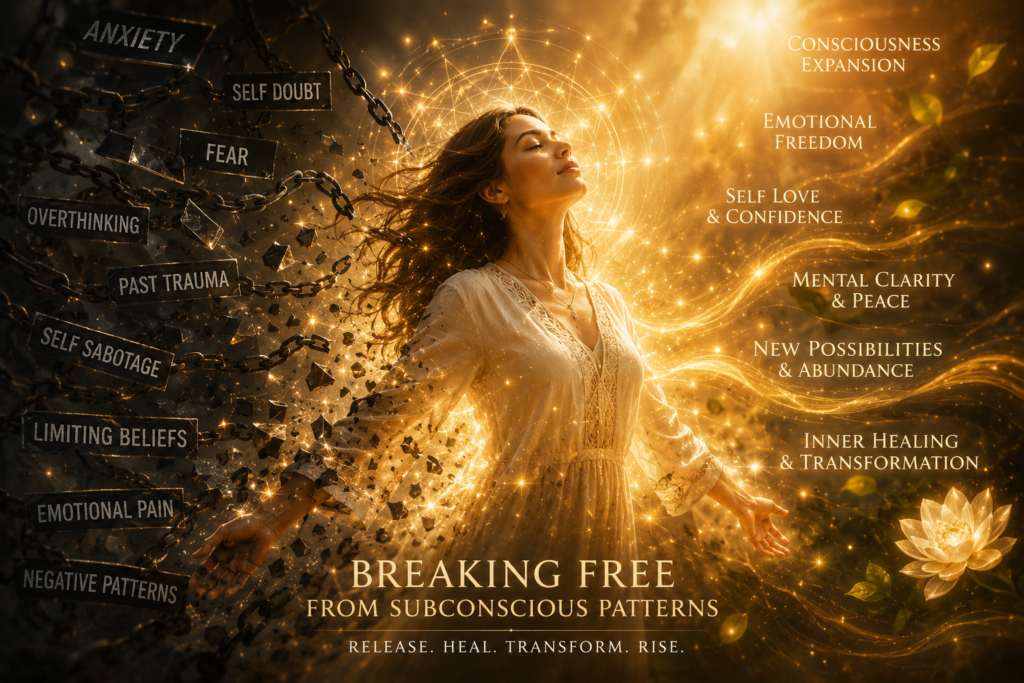
Access Consciousness is a set of tools and processes designed to reduce the charge of judgments, beliefs, and fixed identities — the mental “software” that runs your life. The best-known entry point is Access Bars, where 32 points on the head are gently touched to release electromagnetic charge held by thoughts, decisions, and judgments. Beyond Bars, the Access framework includes processes aimed at dissolving limiting narratives and creating more possibility in daily choices.
How it appears to work (practical language).
Access tools operate by interrupting cognitive-emotional loops. They reduce the electromagnetic/energetic reinforcement of repeated thoughts and judgments, creating cognitive plasticity — the system becomes less automatic. Practically this looks like immediate quieting of intrusive thoughts, reduction of compulsive mental chatter, increased clarity, and often rapid behavioral shifts without the person having to “will” the change.
Clinical niche and strengths.
Access Consciousness is especially powerful when:
- A person has entrenched mental loops (“I’m not enough,” “I must perform,” etc.)
- Overthinking and replaying dominate life
- Quick, measurable behavioral outcomes are required (e.g., stopping a self-sabotaging pattern)
- Clients want change without reliving trauma narratives
Because Access targets “programs” rather than soothing symptoms, it can produce structural results (less reactivity, clearer decision-making, altered relationship dynamics) more quickly than many other modalities.
Science-friendly framing: nervous system, default mode, and plasticity
To integrate these models into a clinical understanding, consider three interacting systems:
- Autonomic nervous system (ANS): regulates arousal and baseline safety. Reiki predominantly influences the ANS, creating a calmer baseline.
- Default Mode Network (DMN) and habitual cognitive loops: these neural networks support self-referential thought and story-making. Access tools appear to disrupt DMN-driven loops, reducing compulsive self-narration.
- Embodied memory (somatic engrams): trauma and repeated activation leave bodily traces — posture, breath patterns, muscular tension. Neither Reiki nor Access magically erases embodied memory in one step, but Reiki creates the safety needed for somatic release, while Access reduces the ongoing cognitive reinforcement that keeps somatic patterns alive.
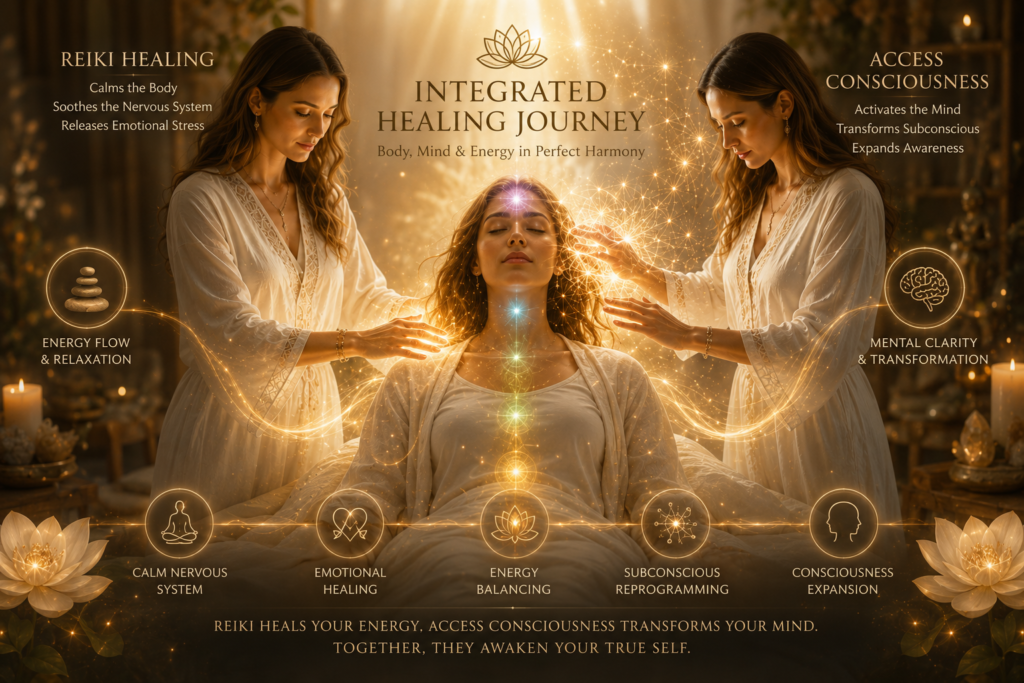
In short: Reiki soothes the hardware; Access rewrites the software. The most robust, lasting change happens when both are intentionally used in sequence and integrated with somatic processing.
Comparative use-cases — when to prefer one, when to combine
Choose Reiki when:
- You are burned out, medically fragile, or emotionally raw.
- You need containment before doing deeper inner work.
- You prefer a non-verbal, gentle approach.
- The goal is restoration, sleep improvement, or emotional stabilization.
Choose Access Consciousness when:
- You are intellectually and emotionally curious to change core patterns.
- You want measurable shifts in behavior, mental quiet, and decision-making.
- You’ve tried “processing” and need the charge that reinforces patterns removed.
- You want fast, durable deprogramming without mandatory re-traumatization.
Combine them (my clinical sequencing):
- Stabilize: start with 1–3 Reiki sessions if your system is dysregulated. This creates the capacity to tolerate change.
- Deprogram: use Access Bars/processes to clear the entrenched mental charge. Expect cognition and behavior to shift.
- Integrate somatically: follow with somatic/energy integration (gentle body awareness, grounding, nervous-system practices) so the new software (thought patterns) and cooler hardware (ANS) lock into a coherent new baseline.
This sequence respects biology: safety first, then change.
Ethical and practical considerations — what honest facilitators must say

- No modality is a cure-all. Promising dramatic life overhaul after a single session is irresponsible. Expect shifts; expect follow-up integration.
- Safety matters. People with active psychosis or acute psychiatric crises require clinical stabilization first. Energy work should be complementary, not substitutive.
- Client agency is primary. Access facilitates choice; Reiki nurtures receptivity. Both must preserve client autonomy and informed consent.
- Measure outcomes. Track sleep, reactivity, relationship conflicts, and daily decision-making. If one modality isn’t moving key indicators, adapt the plan.
Real-world examples (anonymized, pattern-based)
- A corporate executive with chronic anxiety: three Reiki sessions produced measurable sleep improvement and reduced morning panic. Adding Access Bars afterward decreased compulsive planning and allowed delegation; productivity improved without burnout.
- A creative client stuck in self-sabotage: Access work rapidly reduced the “inner critic” voice and facilitated completing projects. Reiki sessions afterward helped the client stay grounded and enjoy results.
- A family in generational conflict: I used Reiki for immediate emotional containment, Access processes to reduce blaming narratives, and family-focused somatic sessions to reroot new patterns in everyday interactions.
Practical checklist: how to choose a practitioner
- Experience & training: verify certifications. As someone who has facilitated globally for 20+ years, I value deep training and supervised practice.
- Integration competence: the best practitioners integrate modalities and work with medical/psychological teams when necessary.
- Ethics & boundaries: clear session agreements, confidentiality, and no coercion.
- Outcome orientation: ask how you’ll measure change and what follow-up looks like.
Final professional recommendation
If you want restoration and regulated presence, start with Reiki.
If you want rapid cognitive and behavioral change, choose Access Consciousness.
If you want lasting transformation, do both — intentionally sequenced and integrated with somatic work.
My clinic blends these approaches with targeted somatic integration so clients don’t oscillate between feeling peaceful and feeling stuck. That combination is why many global clients report not just momentary relief, but durable reorganization of life patterns.
If you’re ready
If you’ve tried gentle modalities and still repeat the same patterns, or if you’ve deprogrammed mentally but can’t rest into your life, I can help design a precise pathway for you — rooted in safety, evidence-informed sequencing, and decades of clinical experience.
Book an orientation session to explore what your system actually needs next — bespoke sequencing of Reiki, Access Bars/Processes, and somatic integration.
— Varshha Sangal