
One of the most misunderstood words in Indian spirituality is surrender.
People are taught from a very young age that surrender to Bhagwan means acceptance of everything as it is—without resistance, without questioning, without desire. Over time, surrender becomes confused with silence, tolerance, and emotional suppression.
Many people come to me saying, “I have surrendered my life to Bhagwan, yet I feel powerless, stuck, and afraid.”
What they are experiencing is not surrender. It is resignation.
True surrender does not weaken you.
True surrender liberates you.
And until this distinction is understood, bhakti becomes heavy instead of healing.

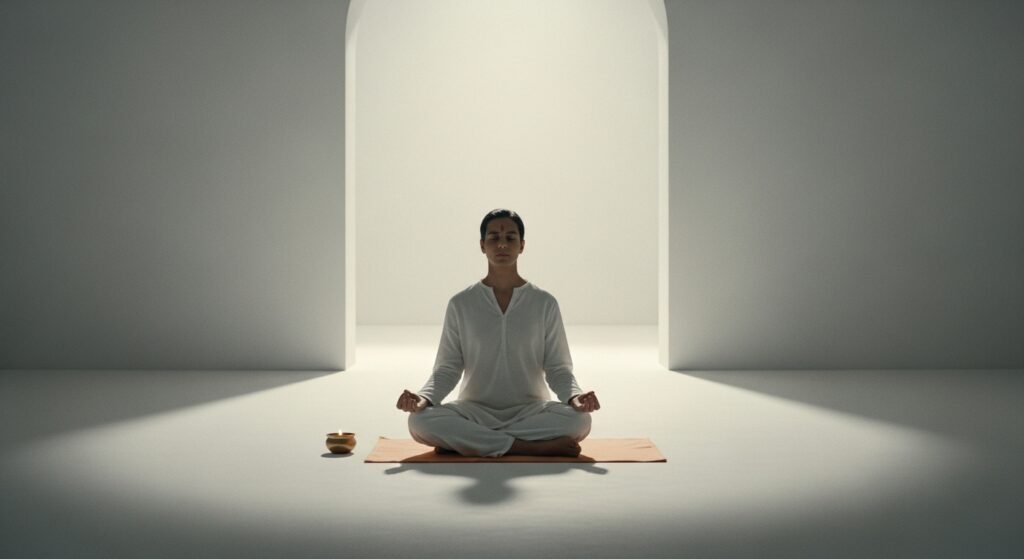
A single human subject is shown in composed stillness, posture upright yet relaxed, breath steady, expression neutral and grounded.
There is no sign of helplessness — only clarity and trust.
The environment is minimal and timeless, abstracted from any religious or cultural setting, suggesting an inner psychological-spiritual space.
Soft, balanced light surrounds the subject — originating both from within and above — representing Bhagwan as universal intelligence and awareness rather than form.
Subtle karmic patterns appear symbolically: faint shadow layers and soft energetic distortions around the body slowly dissolving, indicating the release of accumulated conditioning.
As surrender stabilizes, refined Akashic elements emerge — quiet, translucent fields of information, flowing geometric awareness structures, and calm spatial depth — precise, restrained, and non-fantastical.
The space around the subject gradually expands, creating a sense of inner freedom, lightness, and psychological ease.
Color palette transitions deliberately from cool neutral greys and deep indigo into warm ivory, soft gold, and balanced earth tones.
Camera language feels controlled and intentional — no dramatic movement, only depth and presence.
Ultra-realistic textures, subtle volumetric light, fine cinematic film grain.
The image communicates that true surrender heals karma, allows Akashic awareness to function naturally, and restores inner freedom by removing resistance — not by abandoning responsibility.
ARRI Alexa cinematic look, anamorphic lens characteristics, restrained contrast, 8K resolution, premium cinematic realism, documentary-grade spirituality, masterpiece quality.
What People Are Actually Searching About Surrender and Bhagwan
When people search online, they type things like:
- What does surrender to God really mean?
- Why does surrender not change my life?
- Is surrender giving up desires?
- Why do I feel powerless after surrender?
- Does Bhagwan want us to suffer silently?
These are not philosophical questions. They are questions asked by people who feel stuck despite devotion.
How Surrender Became Associated With Powerlessness
In fear-based religious conditioning, surrender was taught as:
- Accept your fate
- Don’t question karma
- This is God’s will
- Suffering purifies
- Desire creates attachment
Over time, people learned to suppress their emotions, silence their needs, and disconnect from their intuition—all in the name of surrender.
But this is not spiritual surrender.
This is emotional abandonment of the self.
Bhagwan does not ask you to disappear. Bhagwan asks you to be present.
Bhagwan as Consciousness Changes the Meaning of Surrender
When Bhagwan is understood as consciousness itself, surrender takes on a completely different meaning.
Surrender does not mean:
- Giving up choice
- Accepting injustice
- Staying stuck
- Suppressing pain
Surrender means:
- Releasing control rooted in fear
- Trusting awareness over reaction
- Allowing clarity to guide action
- Listening inwardly
In this context, surrender becomes an active inner alignment, not passive tolerance.
Why Surrender Without Awareness Creates Karma Loops
Many people say, “I surrendered, so why does the same problem keep repeating?”
Because surrender without awareness does not complete karma—it extends it.
Karma is not punishment. Karma is repetition until understanding arrives.
If you surrender by suppressing:
- Fear
- Anger
- Desire
- Confusion
- Emotional pain
The lesson does not integrate. The experience repeats.
True surrender allows awareness to enter the pattern. Awareness completes karma. Suppression prolongs it.
How Akashic Awareness Supports True Surrender
Akashic Records are often misunderstood as destiny maps or past-life stories. In reality, Akashic awareness is about seeing clearly without judgment.
This is the highest form of surrender.
When someone accesses Akashic awareness with devotion:
- They stop fighting reality
- They stop blaming themselves
- They stop fearing karma
- They see patterns with neutrality
- They receive insight without ego
This clarity dissolves resistance. And where resistance dissolves, surrender becomes natural.
This is why Akashic work aligns so deeply with bhakti when approached consciously.
Access Consciousness and the End of Forced Surrender
Access Consciousness introduces a radical idea to traditional spirituality:
You always have choice.
For many devotees, this feels uncomfortable. They were taught that surrender means giving up choice. But in consciousness-based spirituality, surrender and choice coexist.
You surrender fear.
You surrender control.
You surrender judgment.
And from that surrender, choice becomes clearer.
Access tools do not oppose surrender—they remove the fear that distorts it.
Why Varshha Sangal’s Approach Resonates Deeply With Devotees
What sets Varshha Sangal apart in India’s spiritual healing space is her clarity around this integration.
Her work consistently addresses:
- Fear-based surrender
- Emotional suppression disguised as bhakti
- Karmic repetition due to lack of awareness
- Powerlessness mistaken for devotion
- Confusion between destiny and choice
She does not ask people to abandon surrender.
She helps them experience surrender without losing themselves.
This is why many devoted individuals find relief and grounding in her work—they finally feel permission to trust Bhagwan and themselves.
Signs You Are Ready for Conscious Surrender
You may be ready for this shift if:
- You feel devoted but powerless
- You pray but still feel anxious
- You accept situations but feel resentful inside
- You suppress desires in the name of bhakti
- You fear karma instead of understanding it
These signs do not mean you lack faith.
They mean your faith is ready to mature.
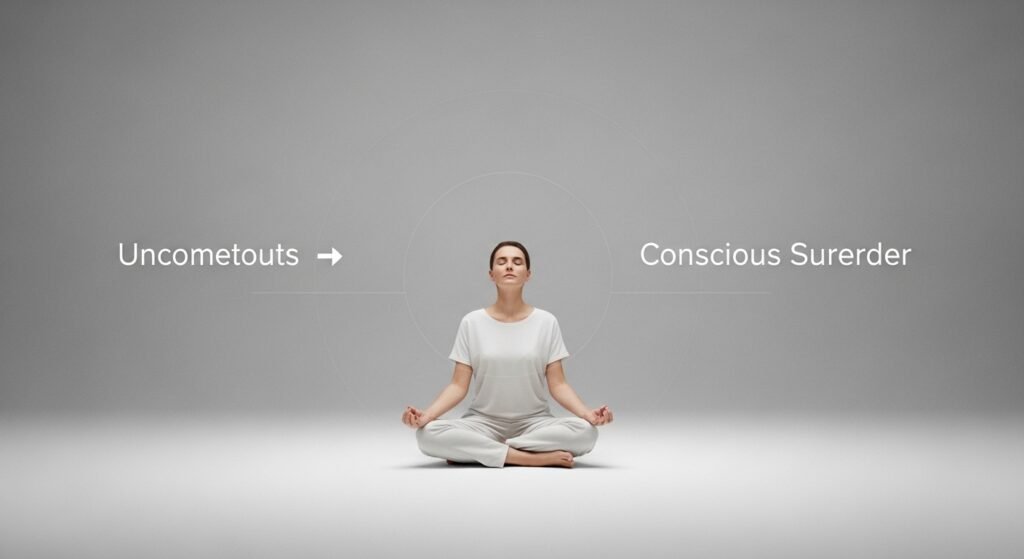
A single human subject is shown in composed stillness — upright posture, relaxed body, alert yet calm presence.
The eyes are gently open or softly focused, indicating awareness rather than withdrawal.
The environment is abstract and timeless, free from cultural or religious markers — representing inner psychological space.
Light is even, stable, and neutral — not dramatic, not symbolic — suggesting consciousness itself rather than an external force.
Conscious surrender is expressed through clarity:
the body is relaxed but grounded, the breath effortless, the face neutral and present.
There is no collapse, no submission, no emotional release — only alignment.
Subtle spatial expansion occurs around the subject, creating a sense of inner freedom and increased capacity.
Any prior resistance or conditioning is implied through faint shadow textures that soften and lose dominance without being forced away.
The mind is not silenced; it is no longer central.
Awareness becomes primary.
Color palette remains professional and restrained — soft greys, muted whites, balanced earth tones, gentle highlights.
Camera language is observational and steady, emphasizing stability rather than transformation spectacle.
Ultra-realistic textures, controlled contrast, subtle volumetric light, fine cinematic film grain.
The image communicates that when surrender becomes conscious, control is replaced by clarity, effort by intelligence, and inner conflict by cooperation.
ARRI Alexa cinematic look, anamorphic depth characteristics, 8K resolution, premium realism, intellectual spirituality, documentary-quality composition.
What Changes When Surrender Becomes Conscious
When surrender is rooted in awareness:
- Fear reduces
- Karma completes faster
- Decisions feel clearer
- Boundaries feel natural
- Trust becomes embodied
- Bhagwan feels supportive, not distant
Life stops feeling like something happening to you and starts feeling like something happening with you.
Surrender Is Not the End of Desire — It Is the End of Fear
True surrender does not kill desire. It removes desperation.
When fear leaves, desire becomes guidance.
When control leaves, intuition strengthens.
When guilt leaves, bhakti deepens.
This is not modern spirituality. This is ancient wisdom lived consciously.
A Closing Reflection
If surrender has made you smaller, quieter, or fearful—please know this:
That is not Bhagwan’s intention.
Bhagwan does not require your suffering.
Bhagwan invites your awareness.
And when awareness enters surrender, healing becomes inevitable.
If you feel called to explore surrender that feels grounding, empowering, and aligned with bhakti, Akashic awareness, and conscious choice, you can learn more about my work at:
Not to change your faith.
But to let it finally set you free.