
This is one of the most painful questions a sincere person can ask themselves. And it usually comes after years of effort, patience, and silence.
People who come to me with this question are not careless or irresponsible. They are usually the ones who have done everything they were taught to do. They studied. They worked hard. They compromised when needed. They stayed loyal in relationships. They prayed. They trusted. They waited. They kept going even when they were tired.
And yet, life feels unresponsive.
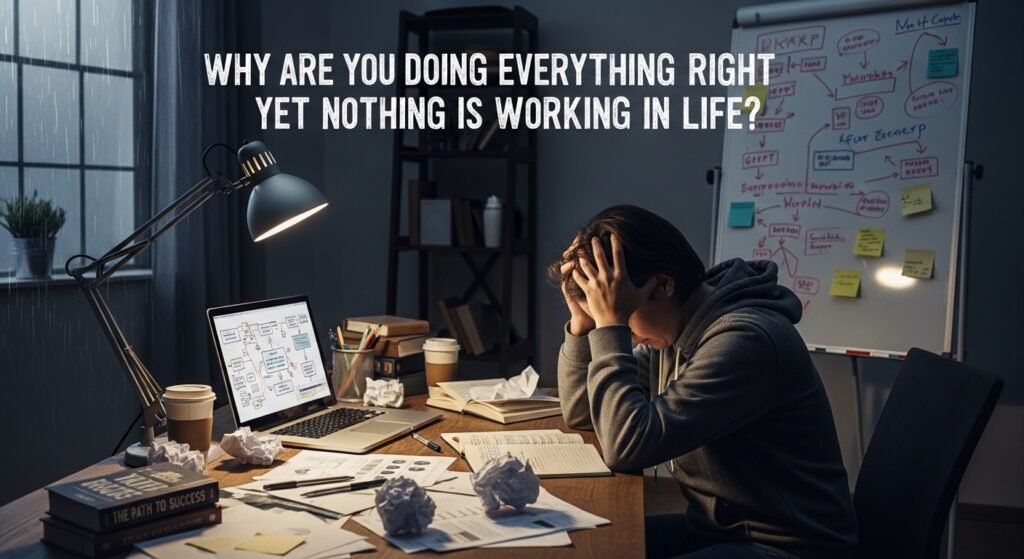
When someone says, “I am doing everything right, but nothing is working,” what they are really saying is:
“I don’t understand what else I’m supposed to change.”
That confusion is deeply unsettling, because effort has always been their safety net. When effort stops working, identity itself begins to shake.
Table of Contents
The Silent Exhaustion Behind “I’m Trying My Best”
What people rarely admit is how exhausting it is to keep showing up without results.
There is a particular kind of tiredness that comes from delayed outcomes. It is not physical. It is not even mental. It is emotional and existential. You begin to wonder whether life is indifferent to you, whether you are invisible to grace, or whether you are fundamentally flawed in some way you cannot see.
Most people do not express this openly because it feels like complaining. They feel guilty for feeling frustrated. They compare themselves with others who seem to move ahead effortlessly and tell themselves to be grateful.
But suppression does not resolve confusion. It only deepens it.
Why Hard Work Alone Is Not the Full Equation
We are taught from a very young age that sincerity guarantees success. This belief shapes our moral compass and our sense of control. But life is more complex than a moral transaction.
Hard work is important. Integrity matters. Effort is essential.
But effort works only when the inner system is aligned to receive the result.
If effort were enough, burnout would not be so common among capable people.
In reality, life responds to:
- Emotional readiness
- Subconscious expectations
- Nervous system safety
- Deep-seated belief patterns
You can consciously want growth while unconsciously fearing the responsibility that comes with it. You can desire stability while emotionally expecting loss. These contradictions are not logical—but they are powerful.

A lone human figure in the foreground, slightly out of focus, standing still.
In the background, quiet repeating patterns emerge — looping shadows on walls, identical silhouettes passing again and again, reflections repeating unnaturally in glass surfaces.
Street lights flicker in the same rhythm, clock shadows subtly cycling, footsteps implied through repeating visual motion.
The repetition is quiet, almost invisible at first — nothing dramatic, just unsettling familiarity.
Colors are muted: cold greys, desaturated blues, soft blacks.
The atmosphere feels meditative, introspective, and slightly unsettling.
Camera remains steady, cinematic framing with deep depth of field.
Soft volumetric light cuts through dust particles in the air.
Subtle film grain, ultra-realistic textures.
The scene communicates unconscious routine, unseen cycles, and silent patterns shaping life.
ARRI Alexa cinematic look, anamorphic lens feel, smooth lighting gradients, 8K resolution, masterpiece quality, slow psychological tension, spiritual undertone.
The Patterns That Repeat Quietly in the Background
When life keeps “not working,” it is rarely random. Patterns repeat because they are familiar, not because they are correct.
I often ask people to look back—not at events, but at themes:
- Do delays keep repeating?
- Do relationships end in similar ways?
- Does progress stop just when things start improving?
- Do you feel responsible for fixing everything?
- Do you feel unsafe resting or receiving?
These patterns are not curses. They are learned responses.
Many of them begin early—sometimes in childhood, sometimes through family dynamics, sometimes through emotionally overwhelming experiences where the system learned that control, struggle, or self-sacrifice equals safety.
Until these patterns are seen, effort unknowingly feeds them.
Why Prayer and Patience Sometimes Feel Ineffective
People often ask me, “If I am praying and trusting Bhagwan, why is nothing shifting?”
Prayer provides strength. Patience provides endurance. But neither automatically rewires subconscious conditioning.
If the body remembers instability, it stays alert even when the mind believes.
If the emotional system expects disappointment, it braces even while hoping.
This creates a gap between intention and outcome.
It is not that Bhagwan is not listening.
It is that your system may not feel safe enough to receive.
The Nervous System Nobody Talks About in Spirituality
One of the most overlooked aspects of spiritual stagnation is the nervous system.
A dysregulated nervous system:
- Interprets uncertainty as threat
- Interprets rest as danger
- Interprets success as pressure
- Interprets peace as unfamiliar
You can consciously want ease, but if your body learned that struggle equals survival, ease feels unsafe.
No amount of positive thinking can override this. No amount of discipline can force safety.
Healing happens when the system learns, slowly and gently, that it is allowed to settle.
“Why Does This Keep Happening to Me?”
This question usually carries shame. People assume it means self-pity.
In truth, it is an intelligent question. It is awareness knocking.
Repetition exists to be noticed. Once noticed fully, it no longer needs to repeat.
Many people keep changing jobs, partners, cities, or routines—hoping external change will resolve internal loops. Sometimes it helps temporarily. Often, the same emotional outcome returns in a new form.
This is not failure. It is information.

What Changes When Awareness Enters
Awareness does not judge patterns. It softens them.
When people begin to see:
- What they unconsciously expect
- What they fear will happen if things work
- What they associate with success or stability
- What they learned about worth and effort
The system relaxes. And when the system relaxes, life reorganises.
Things do not always change dramatically overnight. But they change consistently:
- Less resistance
- Better timing
- Clearer decisions
- Reduced emotional charge
- Fewer forced efforts
Movement begins—not because you pushed harder, but because you stopped blocking yourself unknowingly.
You Are Not Broken — You Are Carrying Too Much Alone
One of the saddest patterns I see is people blaming themselves for situations that require support, awareness, and healing—not willpower.
You are not behind in life.
You are not being punished.
You are not missing some secret rule everyone else knows.
You are responding exactly as your system was conditioned to respond.
And conditioning can be understood, softened, and released.
A Different Way to Look at “Nothing Is Working”
Sometimes nothing works because something deeper needs to be addressed.
Sometimes life pauses not to deny you, but to prevent you from repeating the same outcome in a new form.
When inner alignment shifts, effort stops feeling heavy. Action becomes responsive instead of reactive.
This is when people say, “I didn’t force this—it just happened.”
A Gentle Closing
If you are tired of trying, please don’t conclude that you are weak.
Fatigue is not failure.
Confusion is not incompetence.
Delay is not rejection.
It may simply be time to stop pushing and start understanding.
If this resonates and you feel drawn to explore these patterns with clarity and grounding, you can learn more about my approach at:
Not to change who you are—but to allow life to finally meet you where you stand.